Winter & Spring 2026 ~ Newsletter

Click to navigate to:
2026 Research Symposium | Larval Crab Monitoring | Adult Crab Surveys | Relevant Publications | In the Media

Dungeness Crab Research Symposium
PCRG’s 2026 Dungeness Crab Research Symposium & Annual Meeting was held February 11-12 at the House of Awakened Culture in Suquamish, WA, generously sponsored by the Suquamish Tribe, Port Gamble S’Klallam Tribe, and Swinomish Indian Tribal Community.
The symposium offered a collaborative forum for researchers, fisheries managers, students, and PCRG partners to share ongoing work and align priorities for Dungeness crab research and monitoring efforts across the region. Over two days, participants showcased current projects, exchanged ideas and emerging findings, and contributed to discussions that will help guide future research efforts across the PCRG network.
Day 1 – Research Showcase
Day 1 highlighted the breadth of ongoing Dungeness crab research and collaboration across the region, bringing together 105 attendees representing 33 organizations. A huge thanks to the members of the 2026 PCRG Coordinating Committee, who guide the network:
Julie Barber (Swinomish Indian Tribal Community) | Tribal Rep. #1
Courtney Hart (Port Gamble S’Klallam Tribe) | Tribal Rep. #2
Neil Harrington (Jamestown S’Klallam Tribe) | Tribal Rep. #3
Daniel Sund (Washington Dept. of Fish & Wildlife) | State Rep.
Sean McDonald (University of Washington) | Academic Rep.
Brian Allison (Puget Sound Crabbers Association) | Industry Rep.
Rich Childers (Individual) | Open Rep.
Claire Cook (University of Washington) | Student Rep.
We kicked off the morning with updates from the larval crab monitoring and adult crab survey working groups (see highlights in the sections below!). At lunchtime, a student poster session featured relevant emerging work at institutions along the West Coast:
Rhiannon Holmes (WWU) – Using maternal effects to identify biomarkers for ocean acidification resistance in Dungeness crab zoea
Austin Betancourt-Sanchez (UCLA) – Genetic connectivity and signals of selection across biogeographic barriers of Metacarcinus magister in its native range using whole-genome sequencing (WGS)
Maddie Gard (UW) – eDNA detection of Dungeness crab in Puget Sound
Hannah Brown (UW) – Investigating the data gap between larval and catch abundance estimates of Dungeness crab using molt search data
Sophia Eckhart & Adara Shilling (UW) – Measurement variability in larval Dungeness crab: Calipers vs. ImageJ
The day concluded with a series of research talks spanning Dungeness crab ecology, climate and oceanographic drivers, recruitment and settlement patterns, and applied management tools:
Paul McElhany (NOAA) – Marine carbon dioxide removal and Dungeness crab larvae
Chris Biggs (WDFW) – Sea surface temperature and upwelling as predictors for Dungeness crab recruitment success, fishery landings and population abundance
Emily Bishop (UW) – Facing the future: Interview-based insights on Dungeness crab management in a changing Puget Sound
Carl Ostberg (USGS) – Can we infer capture of European green crab larvae in light traps through DNA analysis?
Paola Lopez-Duarte (Portland State University) – Life-stage patterns in crab larvae from South Sound
Sean McAllister (NOAA) – Dungeness crab quantitative assay development for sensitive and scalable monitoring
Nicole Burnett (Padilla Bay NERR) – Assessing the efficacy of artificial substrates as settlement habitat for crabs
Carl Ng (Hakai Institute) – Navigating the trade offs of thermal plasticity: Climate vulnerability and resilience in juvenile Dungeness crabs under simulated heatwave exposure
Karen Chan (UW) – Larval crabs as indicators of acidification stress via µCT
Megan Hintz (WDFW) – Crab lines with a purpose: Monitoring whale interactions through gear marking
Day 2 – Prioritization Workshop
Day 2 featured a collaborative research prioritization workshop aimed at guiding the next 5-10 years of strategic Dungeness crab research in the Pacific Northwest. The workshop utilized a Q-sort approach to systematically capture and compare diverse perspectives on key research needs, providing a structured and statistically robust framework for identifying shared priorities and areas of divergence. A total of 54 participants contributed to this exercise, representing a range of backgrounds and areas of expertise. The resulting perspectives will help inform the development of an updated research guide for PCRG and the broader regional research community.
Graduate students from the UW’s School of Marine and Environmental Affairs are leading the analysis and synthesis of workshop results. The team includes Kiki Dial, Jo Harris, Charlie Heller, Zoe Tucker-Borrut, and Katie Raab, advised by Dr. Anne Beaudreau. Students will be documenting the methodology used, conducting follow-up interviews to collect supplementary data, and applying factor analyses to identify key themes. Based on their findings, they will develop the first draft of an updated PCRG research guide in the fall of 2026, and will plan to present results at PCRG’s annual meeting in 2027.


Attendees gathered at the Suquamish Tribe’s House of Awakened Culture for the two-day symposium.
Larval Crab Monitoring
PCRG’s light trap network concluded its 7th year of monitoring in the fall of 2025, with 20 sites generating 1,557 new data records. Monitoring efforts were supported by 206 samplers (89 staff and 117 volunteers) contributing over 4,100 hours of effort. The program continues to serve as both a monitoring tool and effective outreach platform, with 947 members of the public engaged through sampling activities over the course of the season.
In British Columbia, Hakai Institute coordinated an additional 29 light trap sites, stewarded by 40 organizations and 260 samplers, the majority being volunteers (https://sentinels.hakai.org).
A dedicated larval crab monitoring working group session was held during PCRG’s annual meeting on February 12, providing an opportunity to review past efforts, discuss updates to our methodology, and prepare for the upcoming season. A hands-on light trap repair and construction workshop was later held on April 3, hosted by Point Defiance Zoo & Aquarium, to support the maintenance and standardization of sampling gear across the network.
Site leads visited Point Defiance Zoo & Aquarium on April 3, 2026, for a hands-on light trap repair workshop and behind-the-scenes tour of the aquarium!
Looking Ahead
The network continues to grow, with two new sites joining the effort in 2026, piloted by Feiro Marine Life Center in Port Angeles and the Nisqually Tribe/Pacific Shellfish Institute in South Puget Sound. This expansion will improve the network’s spatial coverage and strengthen our ability to detect regional patterns in larval dynamics and distribution.
Development of new methodology also continues, with an expanded ImageJ pilot effort aiming to streamline and standardize photo-based measurement data collection and processing during the 2026 season.
Current research leveraging PCRG’s light trap data will further advance our understanding of early life-stage processes and, in the long-term, improve our ability to anticipate changes in Dungeness crab populations:
Heather Gordon (University of British Columbia) – Investigating drivers of larval recruitment in the Salish Sea
Claire Cook (UW) – Developing a larval dispersal model and recruitment indicator in Puget Sound
Chris Biggs (WDFW) – Linking ocean conditions with larval dynamics and recruitment on WA’s Pacific Coast
Adult Crab Surveys
PCRG’s adult crab working group continues to advance its efforts to improve methods for estimating population abundance and understanding adult crab dynamics across the region. A working group meeting was held on April 23, 2026, bringing together partners to review ongoing projects, share updates, and coordinate next steps:
Port Gamble S’Klallam Tribe – Testing a randomized, depth-stratified survey design in Region 2W to assess its feasibility and efficacy at producing data that can be used to estimate adult crab population abundance. Two surveys were conducted in 2025, followed by an additional survey in March 2026. The next phase involves working with Natural Resource Consultants and the broader working group to compare different adult crab survey designs and evaluate their relative performance in generating population abundance information.
Jamestown S’Klallam Tribe – Reassessing the timing of peak molt for adult Dungeness crab in the eastern Strait of Juan de Fuca to determine whether current fishery closure periods are still well aligned. This effort, led by Devynn Gately for her master’s thesis at UW’s School of Marine and Environmental Affairs, includes monthly sampling at 12 index stations over the course of a year to assess shell condition alongside corresponding ocean conditions, including dissolved oxygen and temperature, taken from sensors deployed in pots.
Swinomish Indian Tribal Community, WDFW, and Suquamish Tribe – Piloted adult crab tagging studies in 2025, releasing adult crab with Floy tags in specific regions to determine recapture and reporting rates by recreational and commercial crabbers. The pilot efforts achieved recapture rates of 7-14%, a strong result for this type of study, and the group is considering developing a larger, more coordinated tagging study with clearly defined research objectives.
To learn more about these tagging studies, check out the articles linked in the ‘In the Media’ section below!
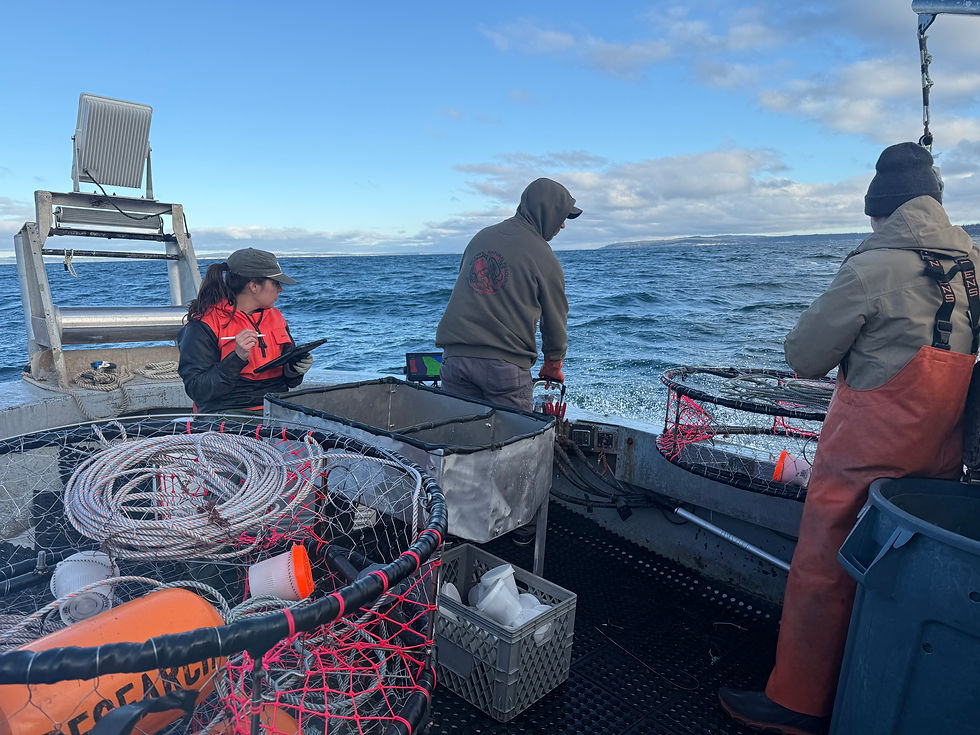
Port Gamble S’Klallam Tribe conducted an adult crab biomass survey in Region 2W in March 2026.
Relevant Publications
[In Review] Genes vs. Environment: Body Size Variation Among Recruitment Cohorts of Dungeness Crab
Dimond et al. | Molecular Ecology
Bednarsek et al. | ACS ES&T Water | April 2026
Rough & Galloway | Ecology | April 2026
Goto et al. | Reviews in Fish Biology and Fisheries | February 2026
Fisher et al. | Ecology and Society | January 2026
Greenberg & McAllister | Marine and Coastal Fisheries | September 2025
In the Media
La Conner Community News | Luisa Loi | April 9, 2026
Building Knowledge About Dungeness Crabs [Radio/Podcast]
KPTZ | Nature Now | March 18, 2026 | Also available on Spotify and Apple Music
Northwest Treaty Tribes | Tiffany Royal | February 2, 2026
The Seattle Times | Caitlyn Freeman | November 26, 2025
Washington Department of Fish & Wildlife | October 3, 2025